

Volumetric Modulated Arc Therapy (VMAT)
An advanced form of IMRT where the radiation source rotates around the patient, offering more flexible beam angles and faster treatment times. VMAT is especially effective for tumors near sensitive structures.
What is VMAT?
Volumetric Modulated Arc Therapy (VMAT) is a cutting-edge form of radiation therapy that builds on the strengths of Intensity-Modulated Radiation Therapy (IMRT). Unlike traditional methods that deliver radiation from fixed positions, VMAT allows the linear accelerator to rotate 360 degrees around the patient while delivering highly modulated beams. This dynamic motion enables faster treatment delivery, improved dose distribution, and exceptional precision—even for tumors near sensitive organs.
How It Works
360° Rotation for Full Tumor Coverage
As the radiation machine arcs around the body, it continuously adjusts the beam’s shape, intensity, and speed. This allows radiation to be delivered from countless angles in a single, seamless rotation.
Advanced Planning Systems
A CT or MRI scan is used to create a 3D model of your anatomy. Sophisticated planning software calculates the optimal path and intensity for each part of the arc—ensuring the most efficient and effective treatment possible.
Faster Treatment Sessions
Because VMAT can deliver the full radiation dose in one or two continuous arcs, sessions are often completed in significantly less time compared to traditional IMRT.
Benefits of VMAT
Efficient Delivery
Shorter treatment times (as little as 5–10 minutes) improve comfort and reduce movement during therapy.
Enhanced Precision
Ideal for tumors located near critical organs or tissues, with a lower risk of collateral damage.
Customized Beam Control
Radiation intensity and beam shape are constantly adjusted during the arc to conform to the tumor’s shape in real time.
Improved Patient Experience
Faster treatment times and fewer sessions can lead to less fatigue and more convenience.
Common Uses for VMAT
VMAT is used to treat a wide range of cancers, especially when high precision is required:
Head and neck cancers
Prostate cancer
Brain and spinal tumors
Pelvic tumors
Gynecologic and gastrointestinal cancers
Recurrent tumors requiring re-irradiation
What to Expect During Treatment
Planning Scan
You’ll undergo a CT or MRI scan to help plan your treatment path. Body molds or immobilization devices may be used to ensure consistent positioning.
Daily Sessions
Each session usually lasts under 15 minutes, with the actual radiation portion lasting just a few minutes.
Course of Care
VMAT is typically delivered 5 days per week over several weeks, but the schedule will depend on your diagnosis and treatment goals.
Learn More About Radiant Cancer Center
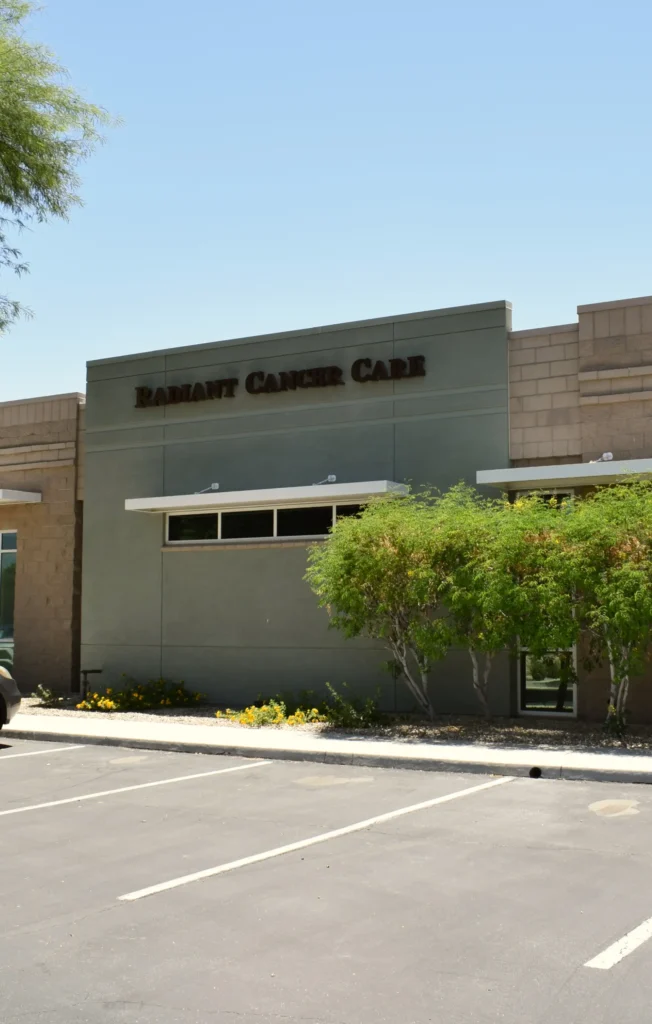
With our office based out of Rancho Mirage, our treatment center is conveniently located to serve the entire Coachella Valley.
Every step of your care is monitored and adjusted to ensure the highest accuracy.
Frequently Asked Questions About VMAT Radiation Therapy
What is VMAT?
VMAT (Volumetric Modulated Arc Therapy) is an advanced form of radiation therapy that delivers radiation while the machine rotates around the body. This allows for highly precise treatment that targets tumors while minimizing exposure to surrounding healthy tissue.
What does VMAT stand for?
VMAT stands for Volumetric Modulated Arc Therapy, a modern radiation technique that uses continuous arc motion and dynamic beam shaping to treat cancer more efficiently and accurately.
How is VMAT different from traditional radiation therapy?
Unlike traditional radiation therapy, which delivers treatment from fixed angles, VMAT radiation therapy delivers radiation in a continuous 360-degree arc. This allows for:
- More precise targeting
- Shorter treatment times
- Better protection of nearby healthy tissue
What is VMAT used for?
VMAT therapy is used to treat a wide range of cancers, especially those located near sensitive organs. Common uses include:
- Brain tumors
- Prostate cancer
- Head and neck cancers
- Gastrointestinal and pelvic tumors
What is VMAT used for in brain tumor treatment?
VMAT is especially effective for brain tumor treatment because it can deliver highly targeted radiation while protecting critical areas such as the optic nerves and brainstem. This precision helps reduce side effects while maintaining effective tumor control.
Is VMAT radiation therapy safe?
Yes, VMAT radiotherapy is considered a safe and widely used treatment. It is carefully planned using advanced imaging and delivered with precision technology to minimize exposure to healthy tissue.
How long does a VMAT treatment session take?
VMAT radiation treatments are typically very fast. Most sessions are completed in about 5–10 minutes, making it more convenient and comfortable compared to some traditional radiation methods.
What are the benefits of VMAT radiation therapy?
Key benefits of VMAT include:
- Faster treatment sessions
- High precision targeting
- Reduced exposure to healthy tissue
- Improved patient comfort
Is VMAT the same as IMRT?
VMAT is a more advanced form of IMRT (Intensity-Modulated Radiation Therapy). While both use modulated beams, VMAT delivers treatment in a continuous arc, making it faster and often more efficient.
Will I feel anything during VMAT treatment?
No, VMAT radiation therapy is completely painless. You will not feel the radiation during treatment, although you may hear the machine moving around you.
Other Services We Offer
Interested in exploring other precision-focused radiation therapies?
Intensity‑Modulated Radiation Therapy (IMRT)
Advanced radiation treatment designed to target tumors with precision while protecting healthy tissue.
Surface-Guided Radiation Therapy (SGRT)
Uses 3D camera systems to monitor patient surface motion in real-time. SGRT enhances accuracy and safety by automatically pausing treatment if movement exceeds designated thresholds.
Image-Guided Radiation Therapy (IGRT)
Utilizes advanced imaging (e.g., CT, MRI, PET) before and during treatment to ensure radiation targets the exact tumor location, reducing margins and improving accuracy.